


1, 2, 3... How much do you know about counting?
- Mrs Desmond
- Feb 22, 2017
- 3 min read
Counting skills are essential numeracy skills young children need to acquire to further develop their numeracy skills. When thinking of what is involved in counting, immediately thought of counting in sequence forward and backwards, skip counting, and an understanding on which numbers are larger and smaller. After exploring further resources, I have discovered counting has a much larger depth. Children need to display four principles to understand counting. These include counting words in the correct order, each item must be counted once and only once, each number must be matched with its own item and the final number reached identifies the total amount of items in the set.
Predictable milestones for early counting. Children begin as a precounter (1 year olds) as they begin to identify objects around them. Once children start to use number words, they have reached the next stage – reciter (2 years old). In this stage children do not necessarily use numbers in the correct sequence and may count more numbers than objects or skip objects and numbers. Children become coresponders (3 years old) when they can correctly use numbers in a sequence and demonstrate one-to-one correspondence with objects. A counter (4 years old) is the next stage where children are able to organize and count the objects. They are able to answer the question “how many” (known as cardinality). Children are seen as producers (about 4 years also) of counting when they are able to count out a certain amount of objects. I can see the relevance for early childhood teachers being aware of this progression to identify children’s current level and develop relevant learning goals.
Although I do not have much recollection of how I learnt to count in the early years, I have been able to scaffold my children with their counting skills and am currently modelling counting for my toddler for when he is ready to begin to recite numbers. Children develop their counting skills through imitating more advanced individuals in their social setting. This begins with children repeating numbers with no meaning attached to begin to apply one-to-one correspondence with objects around them. Through my experiences of my own children I resonate with Westwood and believe children gain understanding with situations important to them. For example, my children love counting their cars, food, how many people in the room or how many trucks we see when driving. Through these interactions with adults and more able peers, many children can rote count to 10 and sometimes 20 when they begin kindergarten. Important for teachers to note that not all children will have developed ability to recite numbers in the correct sequence. There are still many children who had limited exposure to counting or may be developmentally delayed and may have no obvious concept of numbers. Once students begin Prep their counting experiences are extended. Students enhance their understanding that one an d only one number is given to an object when counting. Students will learn to recognize numbers in a set by visually recognizing a number in the set without counting them (known as subitising). Students will begin to learn to write the symbols for numbers 1-20 and be able to represent each number in quantities. Children will learn to count backwards, skip count and begin counting from numbers other than one.
As counting skills is a necessary foundation to numeracy it is important teachers have an array of strategies to include in the classroom. Students will greatly benefit from developing automaticity in basic counting. There are plenty of games and computer programs to practice these facts in a repetitive fun way. Mathspace, which I am using to revise my Maths skills is a great website or app to hone in on students inner competitveness and get students practicing their numbers for points. Scootle is a great educational resource linking in with the Australian Curriculum.
Two games useful for covering the content descriptor ACMNA001 (ACARA, 2012) is
- Number Trains (http://www.scootle.edu.au/ec/viewing/L2317/index.html ) and
- Counting beetles (http://www.scootle.edu.au/ec/viewing/L8281/index.html) .
By using these two games with children, teacher are able to address the curriculum for foundation level by children practicing the counting through naming numbers in sequences, and counting from any starting point.
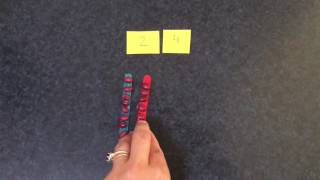
Also check out my video on skip counting
SKIP COUNTING
Comments